Have you ever wanted to learn how to knit? Not sure where to get started? You will want to be sure you have the right supplies when getting started knitting.
Luckily, knitting doesn’t require a lot of supplies to get started. Just beware: it’s addicting, and you may end up with a yarn stash that’s quite large!
This is an update for the current pandemic period… from 3/25/20 – 4/10/20 Bluprint is offering FREE access to all their online classes. They have classes from drawing, sewing, knitting, decorating cookies, and baking. I highly suggest that you and your family take advantage of this at this time when we are all quarantined!!!
Here’s what knitting materials you need as a beginner knitter:
Knitting Needles
Knitting Needle Sizes
These will come in sizes: US sizes and metric sizes. However, most needles will come with both the metric and US sizes printed on them. Be sure you know which size you are using because a US size 7 and 7mm are a LOT different. For my purposes, I use US sizes because that is the most familiar to me.
Now, what size you use depends on the weight of your yarn and your pattern. The smaller the number, the smaller the needle (and the thinner your yarn will be). The sizes range from US 000 – 17 and higher!!

Knitting Needle Types
You will also be able to pick what material your needle is made from as they range from bamboo, aluminum, and even glass. I personally use nickel-plated brass needles because I like the yarn to slide off quickly. Some like the wooden or bamboo needles as it does grip the yarn a little more and the yarn is less likely to slide off accidentally. You will learn what your preferred needle is as you learn and experiment along the way.
Needles also come in different forms: straight, circular, or double-pointed needles (DPNs). Straight needles are used to knit flat pieces like a scarf. Circular are used to knit in the round, like for a sweater bodice or hat. DPNs have also been used to knit in the round, traditionally smaller things, like socks.
However, I use circular needles for everything. EVEN FLAT KNITTING!
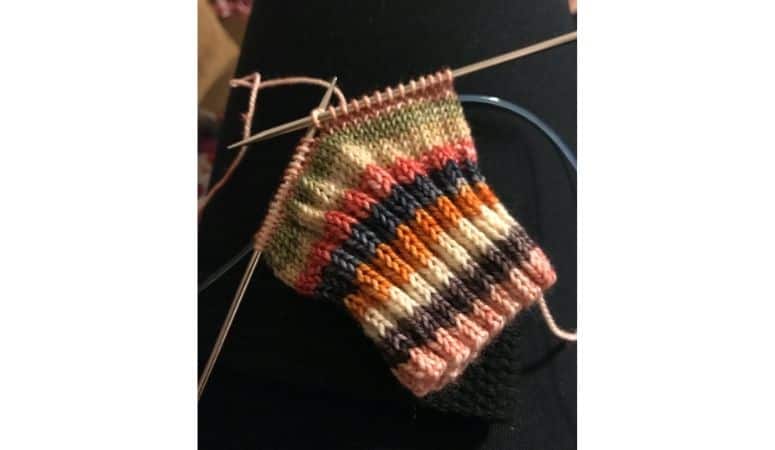
Yes, I use circular needles for literally every single project I work on. They feel the best to me and in my hands. However, that is a personal preference. Some people LOVE straight needles or double-pointed needles (DPNs). Just know, though, circular needles can be used for almost every project you want to work on if you have the right size/length.

You can also get interchangeable needle sets, in which different length cables and tips screw and unscrew together. This is a nice way to get several sizes at once.
What knitting needles are best for beginners?
Tip: I will suggest that you use a larger needle and yarn weight to start with so you can easily see what you are doing, yet not so large it’s hard for your hands to move and learn. When I taught classes in person, I suggested a size 7 needle.
Yarn
Yarn comes in different weights: laceweight, sock or fingering weight, sport weight, DK weight, aran, and super bulky. When the weight of yarn is mentioned, it means the thickness of the yarn. Yarn weight determines how many stitches it takes to make an inch.

You can find the weight of the yarn on the ball band. Yarns have wonderful information posted on their labels or bands. You can often find the needle size suggested printed along with it.

Tip: Also, use a basic yarn. Do not go for novelty yarn (like faux fur or ribbon yarn) at first because you will not be able to see the stitches easily.
Knit Picks has some great Learn to Knit Kits that come with needles, yarn, an instruction booklet, and a yarn needle. You can choose from a scarf, socks, hat, socks, or dishcloths. I highly recommend the dishcloths kit for your first project because it’s very small and you can finish something quickly as you learn, which is very satisfying!
Scissors
Well, you don’t really need scissors. I’ve used fingernail clips in a pinch (on an airplane or in the car). However, I think a small pair of craft scissors come in very handy.
Tapestry Needle
You’ll need these to weave in your ends when you finish your project. You want a large variety of tapestry needles, and they are fairly cheap.
Access to Other Knitters
Don’t worry if you don’t have a group of knitters near you. That would be great if you do, but you can find an online community easily. Even better, you can likely find it in one site: ravelry.com.
This platform allows you to look up endless patterns, see what others have made, log your own projects, log your yarns into your database stash, and find others on the forums for discussion.
Patience
You have to have some patience with yourself and the craft. It takes time to learn, and even longer to get better at it. I still have the first thing I ever knitted: a headband to cover your ears: here is the pattern. It contained a bit more of intermediate skill and I honestly had no clue, and so I knitted away and it had holes and just all kinds of crazy mistakes in all its glory.

My very first knitted item! You can see a ton of mistakes and holes! You have to start somewhere!
On to learning…
Now that you have all your supplies for knitting gathered up, it’s time to start learning. I taught myself how to knit, and then later continued learning from online communities, friends, and knitting groups.
If you are lucky, you may have a learn to knit class somewhere in your hometown. However, if you don’t, and you aren’t a teach yourself kind of person, I highly recommend the Bluprint knitting classes! Bluprint is a great online catalog of classes and they have a ton of knitting classes for all skill levels.
Remember, it’s just sticks and string. If you mess up, unravel it (we call that frogging the work in knitting), and just start over. There is nothing you can mess up that can’t be fixed.
Are you a beginner knitter? Do you have any questions about the basic supplies? Let me know if you have questions about getting started knitting!


Leave a Reply